From Edsel to Yugo: Three Automotive Flops That Made History
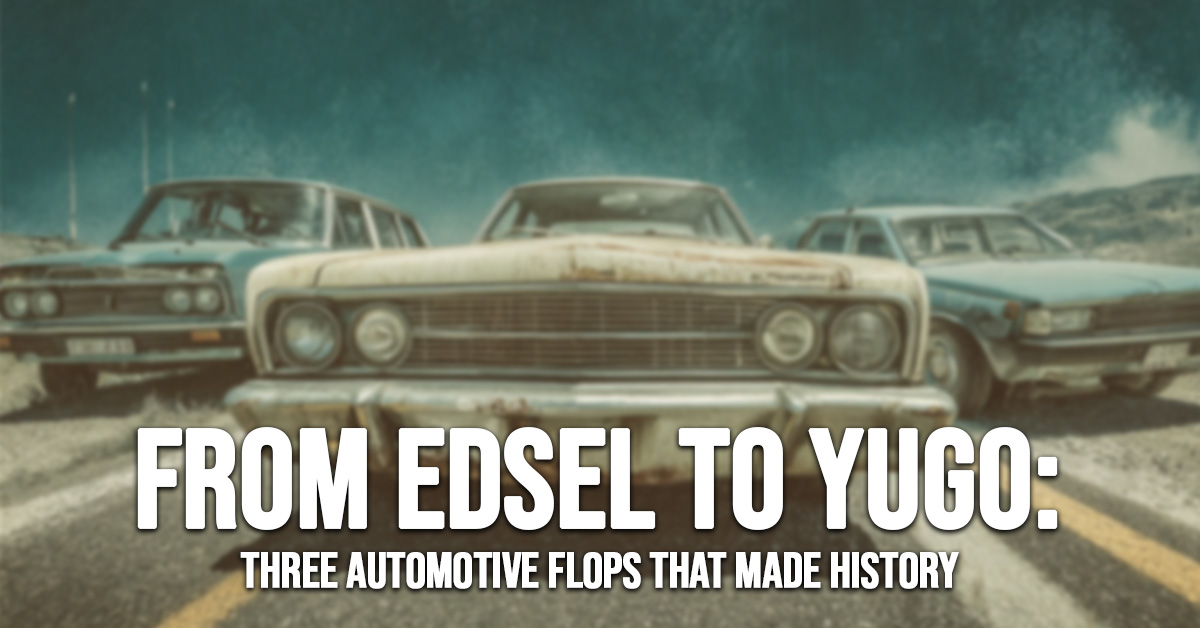
From Edsel to Yugo: Three Automotive Flops That Made History
Automotive history is filled with iconic success stories: the revolutionary Model T, the enduring appeal of the Mustang and Corvette, and the raw power of the Camaro. These vehicles captured the public’s imagination, sold in record numbers, and became woven into the fabric of American culture. Yet, for every home run, there’s a strikeout; for every touchdown, a fumble. The automotive industry, with its massive investments in design, production, and marketing, has also seen its share of spectacular missteps.
Let’s take a look at three classic examples of automotive blunders that serve as cautionary tales in car history.
The Ford Edsel: A Billion-Dollar Blunder
Produced for the 1958 through 1960 model years, the Ford Edsel was a beast in many ways, but not the good kind. It was almost ten feet long and weighed about 4,500 pounds, a significant mass for its era. Its most distinctive—and widely criticized—feature was its front grill, a large, hungry-looking vertical oval with a giant Edsel “E” logo dominating the center. This design element was likened to everything from a toilet seat to a vagina, and it certainly didn’t help the car’s aesthetic appeal. The station wagon edition, in particular, was considered an even greater visual “abomination” by critics.
Ford had ambitious sales targets for the Edsel, needing to sell around a quarter million units to break even. However, public reception was dismal, and the automaker sold less than 120,000 in its entire three-year run. The financial fallout was horrific: Ford lost an estimated $350 million producing the car. When adjusted for inflation to today’s dollars, that translates to a staggering $2.5 billion. Ouch. The Edsel’s failure is a textbook example of misjudging market demand, poor styling, and a rushed product launch.
American Motors: A Day Late, a Dollar Short
American Motors (AMC) was formed in the mid-1950s as the result of a merger between Nash-Kelvinator and Hudson Motor Car Company, two struggling independent automakers hoping that strength in numbers would lead to success. For three decades, AMC bravely tried to compete with the “Big Three” (Ford, General Motors, and Chrysler), but it always seemed to be a day late and a dollar short, consistently bringing “interesting” but often poorly executed models to market.
Think of their more infamous creations: the compact Gremlin, known for its unique “chopped-off” rear end; the sporty Javelin, which had moments of appeal but struggled to capture significant market share; and perhaps most notably, the oddly proportioned Pacer. The Pacer, with its wide body, extensive glass, and asymmetrical doors (the passenger door was longer than the driver’s for easier rear access), was certainly distinctive. It actually sold more than three times as many units as the Edsel in its five-year run from 1975 to 1980 (not 1979-1984 as stated in the original text), with over 280,000 units sold. However, even this relative sales success wasn’t enough to save AMC. Beset by financial troubles, stiff competition, and a failure to establish a consistent, desirable brand identity, the company eventually went “buh-bye” in 1987, acquired by Chrysler in 1988.
The Yugo: The Car No One Wanted
Looking back, it’s almost hard to imagine the Yugo brand lasted as long as it did in the U.S., imported from 1985 to 1992. The idea seemed reasonable enough on paper: a brand-new car Americans could purchase for a couple of thousand dollars ($3,990 in 1985), making it the cheapest new car available. It claimed to get great mileage, which was appealing during a period of fluctuating gas prices. However, while it certainly wasn’t attractive, its real problem was its legendary unreliability.
Made in the former Yugoslavia, the Yugo was, quite frankly, a disaster. Stories of its poor quality became instant urban legends: parts could routinely fall off, leaning against it could create dents, and its performance was abysmal. It was widely mocked for its shoddy construction, slow acceleration, and general lack of safety or comfort. The last Yugo was produced in Serbia in 2008, but its reputation in the U.S. was permanently cemented as a symbol of automotive failure. It is unknown how many Yugos are still drivable in the United States today; some claim none of them were ever truly suitable for the road.
These three automotive missteps serve as vivid reminders that while innovation and bold ideas are crucial, they must be tempered with market understanding, quality control, and a realistic grasp of consumer expectations.
Just like the Yugo, it can be possible to spend too little on your car insurance, potentially leaving you vulnerable when you need protection most. Cheap insurance may not meet state minimums, offer lower protection levels than you deserve, or have dangerous gaps in coverage that expose you to significant financial risk after an accident. A one-on-one consultation with one of our independent auto insurance agents could provide invaluable insights. Not only can they help craft an auto insurance plan tailored specifically for your situation, but they can also shop their extensive network of companies to get you a competitive price. Connect with us today to get started on your updated automobile insurance policy and avoid your own “automotive misstep” in coverage.
Do you have questions about your insurance? Find an insurance agent near you with our Agent Finder
Search All Blogs
Read More Blogs

Commercial Readiness for the Q4 Rush
Prepare your business for the high-stakes fourth quarter by auditing commercial property, liability, and cyber insurance portfolios.

The Late-Summer Financial Reset
Conduct a mid-to-late-year financial reset to update your life insurance coverage, review beneficiary designations, and secure your family’s future

Navigating the Back-to-School Rush
Navigate the high-density back-to-school traffic rush safely by practicing defensive driving and optimizing your family auto insurance policy.

Home Insurance: Preparing Your Property and Policy for the Autumn Shift
Prepare your property for autumn with essential maintenance and ensure your homeowners insurance policy covers current construction costs.

Beyond Income Replacement: Utilizing Permanent Life Insurance for Intergenerational Wealth Transfer
Secure your family’s financial future across generations. Discover how permanent life insurance and estate planning tools transform death benefits into lasting legacy wealth.

Navigating the Golden Years: Auto Insurance Strategies for Senior Drivers and Multi-Driver Families
Support safe driving across all generations. Learn how senior auto discounts, defensive driving courses, and multi-driver policy optimization protect your family on the road.

The Multi-Generational Home: Upgrading Your Insurance for Aging-in-Place and Family Safety
Welcoming aging family members into your home? Discover how to upgrade your property safety and insurance coverage to support multi-generational living.

Bonds That Build Nations: Celebrating World Humanitarian Day and the Power of Shared Purpose
Celebrate World Humanitarian Day by exploring the profound impact of global aid, community support, and the enduring power of human empathy.

Operational Continuity: Securing Your Enterprise Against Unforeseen Market Shocks
Protect your business from catastrophic disruption. Learn how comprehensive commercial policies safeguard your revenue, assets, and reputation through any crisis.

The Ultimate Safeguard: Designing a Life Insurance Plan That Outlasts Uncertainty
True security means knowing your family’s future is permanently protected. Discover how a comprehensive life insurance strategy secures multi-generational wealth.