America’s Linked Cities: Six Communities Forever Entwined
America’s Linked Cities: Six Communities Forever Entwined
In the vast tapestry of American geography, while most cities stand distinctly on their own, there exists a unique phenomenon: communities so geographically and culturally intertwined that it’s almost impossible to separate them. In fact, we often refer to these conjoined urban areas by a single, combined name, reflecting their inseparable identities. This isn’t necessarily rare, but it’s not common either – these are places where growth, history, and proximity have forged an eternal link. Here are six such areas across America that are seemingly forever connected.
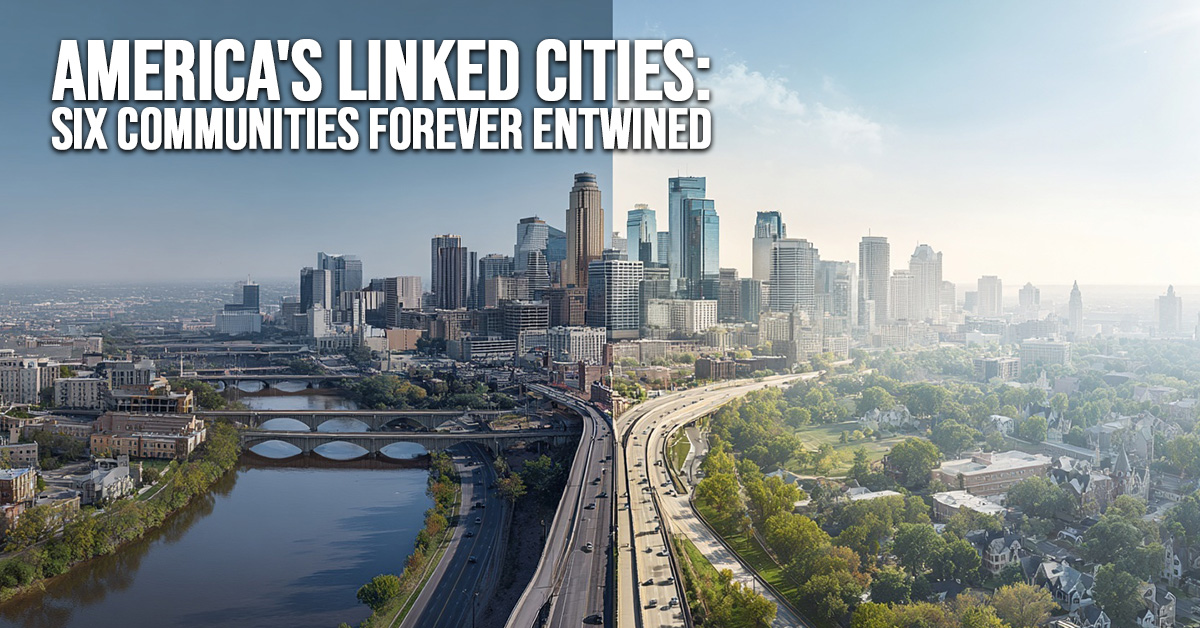
The undisputed champion of linked cities, topping any such list, is what is famously known as the Minneapolis-Saint Paul, Minnesota. Referred to globally as the “Twin Cities,” their Major League baseball team even proudly carries the moniker of the “Twins.” Situated strategically at the confluence of the mighty Mississippi River, the Minnesota River, and the St. Croix Rivers, their history holds a surprising twist. While today it’s Minneapolis and St. Paul that share this iconic designation, the original “twin” to Minneapolis was actually a town called St. Anthony, which merged with Minneapolis in its early days. Minneapolis and St. Paul continued to grow independently through the 1820s, 1930s, and 1940s, eventually evolving into the dual metropolitan powerhouses we know today.
Further south, along Florida’s Gulf Coast, we find another famously linked pair: Tampa and St. Pete, Florida. Is it St. Petersburg, Florida? Tampa, Florida? Or simply “Tampa Bay”? No wonder we often refer to this vibrant region simply as Tampa-St. Pete. The reality is, St. Petersburg (named, perhaps unexpectedly, after the Russian city) and Tampa are two distinct, separate communities situated on either side of Tampa Bay, a large, bustling body of water that serves as a vital shipping, cruise, and recreational center. St. Petersburg is the less populated of the two cities, with approximately 265,000 residents, while the city of Tampa is significantly larger, home to about 395,000 people. Adding to the delightful confusion, the city of St. Petersburg is actually home to the Tampa Bay Rays MLB team, while the stadiums for the NFL Buccaneers and NHL Lightning are located across the bay in Tampa itself.
Moving to the Carolinas, we encounter Raleigh/Durham, North Carolina. These two separate communities are both key components of the academically and industrially renowned Research Triangle Region of North Carolina, which prominently includes Duke University. Durham has a population of approximately 277,000 people, with another 479,000 residents living in Raleigh. Their proximity and shared economic engine in the Research Triangle Park have created a synergy that makes them an almost inseparable pair in the minds of many.
Just a mere mile apart, the story of Winston-Salem, North Carolina is unique because they actually officially merged. Winston and Salem, North Carolina, existed as separate communities within Forsythe County until 1913, when they officially unified to become the single city of Winston-Salem. Today, this consolidated city boasts a population of about 250,000 and is proudly home to Wake Forest University and several other colleges. A curious side note: the popular cigarette brands Winston and Salem were indeed named after these distinct cities, and not, as some might assume, vice-versa.
On the border of two states, we find a pair that often causes geographical confusion: Kansas City, Missouri and Kansas City, Kansas. Although the two can frequently be mistaken for one another, when most people refer to “Kansas City,” they are typically referring to Kansas City, Missouri, which sits along the western edge of the state bordering Kansas. Kansas City, Kansas, has a population of about 150,000 people, while its larger sibling, Kansas City, Missouri, is home to a substantial 481,000 residents. Despite being separate cities in different states, their shared name and contiguous urban sprawl make them inextricably linked.
Finally, in the heart of Northern Texas, the blending of Dallas-Fort Worth, Texas has become almost an unstoppable force. As these communities experienced tremendous growth over the past 50 years, suburban expansion, an intricate network of freeways, and a developing rail system have now connected the cities forever, creating one of the largest metropolitan areas in the United States. Technically still separate cities, Fort Worth has a robust population of about 775,000, with Dallas adding another impressive 1.25 million residents. Those who live in the region often characterize Fort Worth as being more laid-back and reflective of its Western heritage, while Dallas is typically seen as more urban, cosmopolitan, and fast-paced, offering a complementary balance within the vast DFW metroplex.
Just as these cities blend common factors with unique characteristics, so too does insurance. Insurance blends the factors you may have in common with other people (like your age or location) with factors entirely unique to you (like your specific home’s features, your driving record, or your business type). That is precisely why price quotes for auto, home, life, and even business insurance can vary so widely from person to person and from company to company. To ensure you are getting the most value for your premiums and the most comprehensive coverage for your unique situation, we encourage you to take a proactive step. Contact one of our independent insurance agents today for a no-cost, no-obligation insurance review and price quote. We look forward to assisting you in finding the perfect fit for your needs.
Do you have questions about your insurance? Find an insurance agent near you with our Agent Finder
Search All Blogs
Read More Blogs

Hitting the Trails: Why October Is the Ultimate Month for Hiking and Outdoor Exploration
Make the most of autumn weather with tips for safe, scenic weekend hiking and outdoor adventures.

Umbrella Policies for Businesses: Adding an Extra Layer of Defense Against Major Lawsuits
Shield your business assets from massive liability claims with a commercial umbrella policy.

Business Continuity Planning: Using Key Person Life Insurance to Protect Your Enterprise
Safeguard your company’s financial stability and continuity with strategic key person life insurance.

Understanding Uninsured Motorist Coverage: The Hidden Shield on Your Auto Policy
Protect yourself from reckless drivers with comprehensive uninsured motorist policy coverage.

Smart Home Tech and Insurance Discounts: How Automation Lowers Your Premiums
Lower your home insurance bills by integrating smart home monitoring and safety technology.

Fueling Your Body for Cooler Days: Exploring Autumn’s Best Harvest Superfoods
Boost your immune health and energy this fall with delicious seasonal harvest recipes and superfoods.

Beyond the Basics: Understanding the Critical Role of Business Interruption Coverage
Protect your company’s cash flow during unexpected operational shutdowns with business interruption coverage.

Locking In Your Advantage: Why Buying Life Insurance Early Locks in Lifetime Savings
See why locking in a life insurance policy during your 20s or 30s yields massive long-term savings.

Teen Drivers and Auto Insurance: Strategies for Managing Premiums Without Sacrificing Safety
Navigate adding a young driver to your auto policy while keeping premium costs under control.

The High Cost of Building: Why Your Home Replacement Value Needs an Update This Year
Ensure your home rebuilding limits keep pace with current construction inflation rates.